About the Shelter
The first time I remember going down to it was during the Six-Day War. A small boy, five years old, grabbing the railing and rushing down the building’s stairs a few steps ahead of my mother, who is carrying my baby brother. The siren wailing loudly from somewhere, echoing through the stairwell and ushering us to the small, damp shelter located under the building. I stood in the cramped space, studying with interest the worried faces of the neighbors and trying to understand the drama unfolding around me. In the following days, several folding beds were placed against the shelter walls, and we slept on them at night until the end of the short war. The vague memories that the shelter left me from those days were the crowding in the dim light and the feeling of alienation among adults I didn’t know. Added to these were the musty smell in the stagnant air and the dust that covered the floor, stairs, and every other surface. I remember staring at the escape hatch high on the south wall and wondering how I would be able to climb up to it in an emergency in the absence of a ladder or any other means. The war ended without me having to extricate myself through that emergency exit. The beds were folded and put away again, and I waited impatiently to start kindergarten. Fragmented memories I carry with me since then, like faded photos in an old album that was never photographed.
The next time I returned to that space was in fifth grade. The Yom Kippur War broke out on Shabbat. That morning, I went out to my grandparents’ house, who lived not far from us, to ride my grandfather’s big bicycle through the empty streets. The rear tire was slowly losing air due to a tiny flat, forcing me to return and inflate it frequently. Between stops, I noticed the increasing number of vehicles moving on the roads. I understood that something unusual was happening. A random conversation I heard exchanged between balconies, in which the word “war” was repeated several times, prompted me to return home earlier than planned. Around 2:00 p.m. that day, the first alarm wailed. Once again, I found myself in the familiar shelter, now packed with various items that had been stored there in the months and years leading up to the war. There were more children in the shelter, who were older, and it was more crowded than it had been six years earlier. Over the next two days, I made sure not to stray too far from home so I could reach the shelter quickly, but in retrospect, this was the only time during that war that we went down to it.
The Yom Kippur War was over, and we returned to normal life, but not long after that, we returned to the shelter. This time it was at the initiative of the girls in class who, toward one weekend, announced a class party on Shabbat eve. To my grave disappointment, I missed the first party because I was sick, but to the one that was held the following week, I arrived with great enthusiasm. It was held at Irit’s building shelter, on Tel Chai Street. We gathered there, nicely dressed, imbued with enthusiasm and curiosity mixed with worries and youthful hopes. The shelter was empty of belongings except for one or two benches pushed against the wall. A small cassette tape played a collection of hits recorded from the weekly song countdown, and a single light bulb hung from the ceiling, illuminating the room with a dim light. The dark shadows that flickered on the bare concrete walls added to the electrifying atmosphere of that first, magical romantic evening. Dina quickly instructed us on how to dance Shake and Slow like the grown-ups, and we all imitated her enthusiastically. The cassette tape played, and we freed our young bodies in left and right Shake movements to the beat of the music, studying the faces and movements of those around us in an attempt to learn and improve. The extra special moments that evening were the Slow dances. A boy and a girl stand at a safe distance facing each other. The boy places his hands on the girl’s hips, and the girl places her hands on the boy’s shoulders, and they both move left and right to the beat of the music, their gazes barely meeting. Instead, they glance to the sides, wondering who is dancing with whom, and how close are they standing to each other? The excitement is rising, and so are the hopes that the song will continue and not end too soon or at all, because holding a girl’s waist like that was no small matter at that time. How adult we felt, how mature. How free! The future looked brighter than ever in those moments, and then the song ended. Daydreams.
These class parties were held several times in a similar format for the rest of that year, and they too were eventually abandoned in favor of other things. The various shelters in the neighborhood we wandered through were all the same size and exuded the same atmosphere. A dim mist, a pleasant coolness, and a kind of protective privacy from the outside world. They gave those sheltering in them a sense of security during wars and a sense of privacy in times of peace. These shelters were simply built and lacked any modern protective features. The main elements that guided the brutalist-minimalist style in which they were built were basic, simple planning and cost-saving. Newer buildings built later featured more modern shelters with better effective protective measures, such as blast doors, air filters, as well as a larger area suitable for extended stays. Later, with the development of greater technological and security threats, these public spaces were also abandoned in favor of the Residential Secure Space. Between one war and the next, the old shelters continued to serve as a public storage for the building’s residents. Class parties and disco dances were likely also relegated to the past and nostalgia.
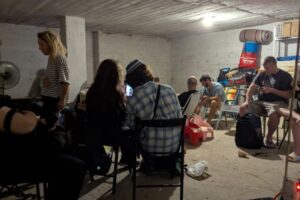
This year it happened, and during the war between us and the Iranians, I found myself fleeing to a shelter again. This time it was under an apartment building in the heart of Tel Aviv, where we lived during our visits to Israel. More than half a century had passed since that first war when I stayed in the shelter of my childhood home, and yet the current shelter, larger, spacious, safer, and more modern, also exuded the same dank coolness, friendly foreignness, and protective brutalism. In this shelter, too, a single light bulb flickered in each of its four rooms. Old dust covered every horizontal surface, and various objects such as an old computer desk, a tattered chandelier, and cardboard boxes were piled up in several corners. The collection of residents who gathered there during every missile alert soon became a familiar group, whose members exchanged experiences, supportive advice, and soothing conversations. From time to time, the group was joined by occasional guests, such as a bunch of half-drunk partygoers from the pub on the ground floor late one evening, or a bus driver and his few passengers who sought shelter during an early morning ride. Children of our age back then and younger gathered in perfect order following their parents in the last room, the family room, where they sat on picnic blankets and played board games in the dim light. There were also those who came to the shelter who found solace in listening to music or other sounds through personal headphones. The large shelter was quiet most of the time we were there, waiting to hear the sounds of the interceptors and the hits, examining the faces of those around us, and exchanging reassuring smiles. The descents to the shelter were all hasty but conducted in perfect order. The ascents from it were slow and thoughtful. We did not stay in the shelter beyond the time we were required to snuggle in it. Going down to it became an annoying but necessary habit, and we tried to respect the occasion by behaving calmly and confidently. We did not know how long we would need to stay there each time we gathered within its walls, nor how long would the war last. On the morning the ceasefire was declared, I passed by the door that was still open, ready to receive residents and passersby. The light down the stairs was on as it had been on previous days. I went downstairs for a farewell visit, inhaling the cool, familiar moss and surveying the public space that was now, for the moment, all mine. The benches, the chairs, as well as the hoard of belongings stored in the last room were laid out there as before, ready to host the guests of the next war or perhaps some class party, whichever came first. Enough with this romance, I thought. The pale light accompanied me up the stairs to the bright present outside. The street was loud. Bustling life had resumed its course in this small-big nation where every street and neighborhood are a city of refuge.
 Love is a vault of protection,
 A universe-size onion,
 She was called into port one fall evening,
 הפעם הראשונה שאני זוכר את עצמי יורד אליו הייתה במהלך מלחמת ששת הימים. ילד קטן, בן חמש, אוחז במעקה וממהר מטה במורד מדרגות הבניין מספר צעדים לפני אמי הנושאת את אחי התינוק. הסירנה מייללת רמות מאי שם, מהדהדת בחלל חדר המדרגות ומלווה אותנו אל המקלט הקטן והטחוב הממוקם מתחת לבניין. עמדתי בחלל הצפוף, בוחן בעניין את פניהם המודאגות של השכנים ומנסה להבין את הדרמה המתחוללת סביבי. בימים הבאים הוצמדו מספר מיטות מתקפלות לקירות המקלט ועליהן ישנו בלילות עד לתום המלחמה הקצרה. הזיכרונות העמומים שהותיר בי המקלט מאותם ימים הם הצפיפות באור העמום והרגשת הזרות בין מבוגרים שלא הכרתי. נוספו אליהם גם ריח העובש באוויר העומד והאבק שכיסה את הרצפה, המדרגות, וכל משטח אחר. אני זוכר את עצמי תולה עיניים בפתח החילוץ הגבוה שבקיר הדרומי ותוהה כיצד אוכל לטפס אליו במקרה חרום בהעדר סולם או כל מתקן אחר. המלחמה הסתיימה בלא שנדרשתי לחלץ את עצמי דרך אותו פתח חרום. המיטות קופלו ואוכסנו מחדש ואני המתנתי בקוצר רוח להתחיל ללכת לגן חובה. זיכרונות תלושים שאני נושא מאז, כמו היו תמונות דהויות באלבום ישן שלא צולם מעולם.
 I can measure time by days, weeks, and months,
 ,לְמִלְחָמוֹת יֵשׁ רֵיחַ שֶׁל טַחַב
 ,בַּחֲלוֹמוֹתַי הָרְדוּפִים
 Love is an egg,
 .הַבּוֹקֶר הֶחְלַטְתִּי לְהִתְקַשֵּׁר לְאַבָּא שֶׁלִּי
 A thought about a friend,